
My inspiration towards getting outside onto one of the UK’s national parks, is enlightened by views, like the one in the picture.
The view is on Dartmoor National Park, and looks over over Plymouth and surrounding area.
The picture was taken after a snowstorm called Storm Bert, November 2024. Taken whilst I was on my assessment.
The lead up to November 2024, I found myself submerged into all things linked to navigation.
Watching many of the YouTube subject matter experts, talking to other qualified people, taking time to walk using a map and compass, even if it was along a route I had walked before, all in preparation for a weekends assessment on Dartmoor on a qualification that would meet both my skill level, the map to compass element and the need to understand the terrain, linking it back to the map.
I also have a need to become a leader on the terrain I desire to work on to meet my personal goals.
Research
Prior to enrolling onto the course, I had researched the many different options including sector accredited certificates and National Qualifications and courses monitored by Ofqual.
My deliberation and gaining the confidence to break my impostor syndrome took me many years to get to a level of commitment. The research took me many hours, if not days of deliberations, until I had found a qualification, and a course provider that I thought would enable me to demonstrate my skills, and most of all progress my desire to step into a world of sighted sector experts.
The main aim is simply to encourage more people living a life with protected characteristics enter into the community of Moorland walkers and leaders. Break the mould of what the typical leader looks like and change the direction of a sector that sees stereo type categories of humans.

Spoilt for choice.
However, my research had taken me on a different journey than the one I had expected.
I had read endless website blurb, the blurb that is written because it sounds political correct, rather than what is really meant. We have all seen this type of website. Then only to eventually find out that the words only mean more in a game of “Inclusive Scrabble”.
The research simple narrowed my choices down to two.
Both choices were simple linked:
- The same theories on navigation.
- Both having high volumes of people becoming active qualified hikers and leaders.
- Both have training that is a reasonable distance to my home.
This journey had also led me to holding an interesting, yet a long conversation, with an independent trainer, a trainer who had gained over twenty years of experience. There experience was linked to career in navigation training. The career had been mixed between being a teacher at a local six form college delivering an outdoor program, to eventually taking early retirement, and starting a business that simple replicated his past employment at the school and became what his business is today, but without the bureaucracy of children’s education.
The person also makes a reasonable living, and has a superb life with a mixture of worldwide adventures, working within the navigation sector, and with a friendly supportive network that offer opportunities beyond the requirements of their own business.
One of my strong influencers, simple came from the peer pressure around me in the scouting world. The qualification I choose, currently seems to be an industry favourite, enabling job opportunities within the UK’s education system.
The following paragraph comes from a national problem, that is leading to an increase in the need for a qualification.

To lead a team to take part in the Army’s event, the Ten Tors challenge, the army recommended that a team manager holds one of the three types of qualifications and the enhanced first aid course linked to mountaineering.
This requirement evolved from the legal findings from a tragic accident, whilst on the challenge. The need to improve the skills of the team managers and the training from the supervisors to the contestants. The previous benchmark had been simple experienced and committed to the training.
This change towards qualifications, training and on going skills levels, in turn, annually increased the skills of the 2000 contestants that make it through the academic or the associations selection processes. Plus an estimated number of 1000 young people, that commit, train and simple don’t get selected.
Bare in mind that this change to the event management happened over 20 years ago.
Part of the Army’s selection includes another high volume of humans.
Each year, 400 teams enter for one of the 240 team places. The 400 teams all submit an entry for a team, all with qualified managers and supervisors, agreement to the training regime and mainly run by volunteers.
Qualification Option One:
The National Navigation Award Scheme (NNAS)
The statement from their website.
The advancement of education of adults and young people, on the subject of land navigation skills in order to promote their safety and welfare when taking part in various outdoor pursuits, through the development of structured educational programmes.
Option Two: Mountain Training

A diverse and active outdoor society, supported by inspirational leaders, instructors and coaches.
Comparisons
Qualifications
Mountain Training
- National Navigation Award Scheme
- Three terrain type qualifications, all at level 3. All with learning outcomes linked to the safety, navigation skills required, the people taking part in the training.
- Both have a huge number of people gaining qualifications.
- Both are governed, following rigid monitoring regimes.
- Mountain Training is governed by Ofqual, the UK’s official education body. Run for profit.
- National Navigation Award Scheme is registered charity and is has public access to information and accounts. The qualifications are SNVQ accredited upto level 6. Non for profit.
My choice
My choice went to Mountain Training,
they have some great statements that lead me towards them. They write in the way that led me to understand what inclusive means. This included a fund to support an “assistant” for people with needs. Actively seeking to encourage “minority” groups.
They have three different types of qualifications,
The qualification provider has strong partnerships with the navigation sectors I worked with, especially scouting and the local Army navigation challenge called Ten Tors.
Support from an assistant or support worker.
Over the years of my journey into blindness,
I have maintained my love of the outdoors. Aiming to avoid the topic about my disability and focusing on my abilities to navigate.
Some people simple, mainly from my own friendship group, ignore my approach to walking. Only prompting me when I am at risk or just for humour.
Others are all over each step I make, constantly making sure I understand what is above or below my nose.
Part of my the idea to aid people living a life with a protected characteristics is to also look at the training of the assistant or support worker. There isn’t a one course for each element or suits the needs. However, from experience, I believe that the needs are similar and can be addressed with common knowledge and experience. There is also a need to change the blurb approach towards poor inclusiveness wording on websites. Especially the term “minority group”.
Tools and Tricks.
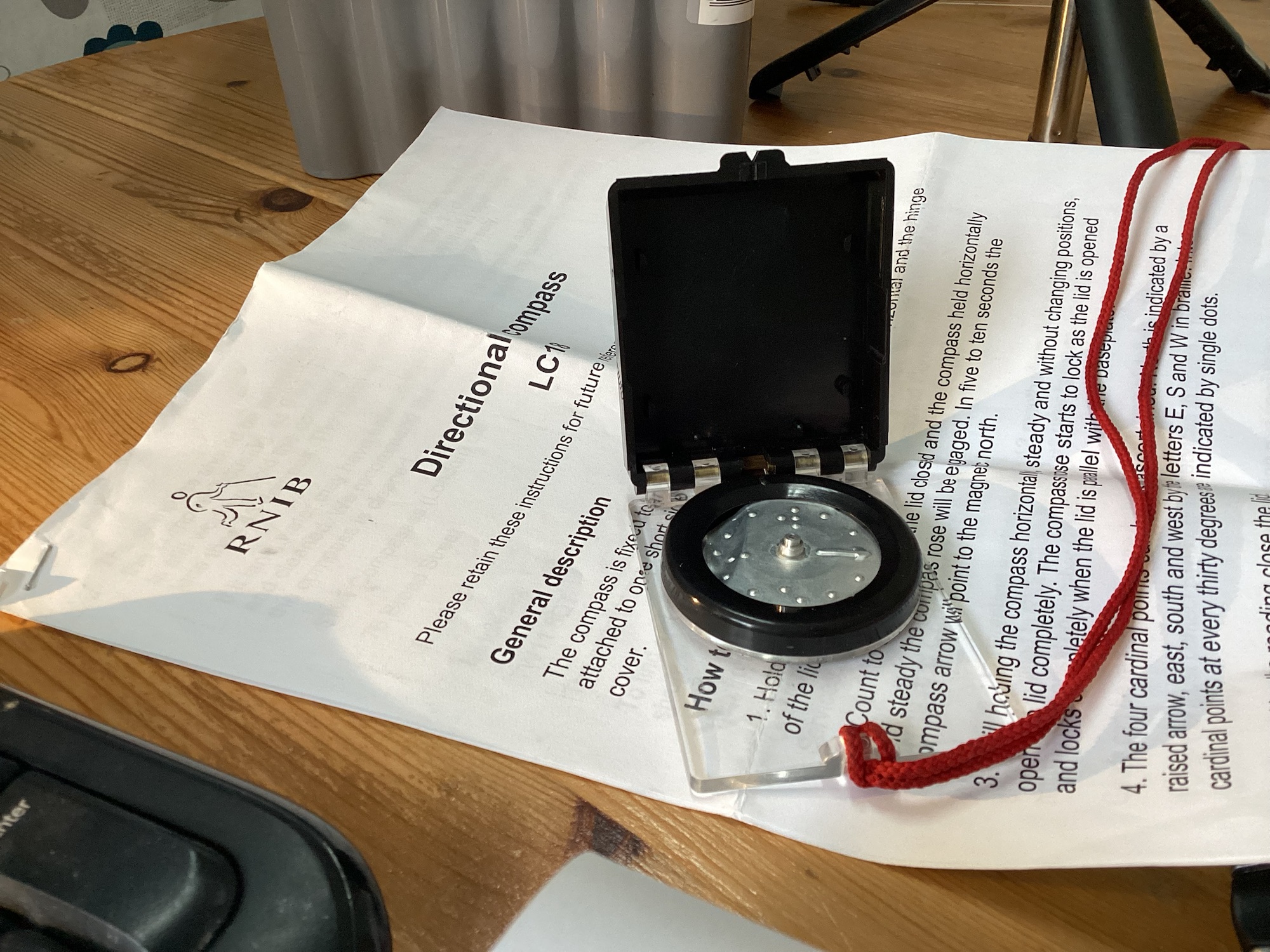
I have even been gifted by a vertual friend from my Blind Man Roy’s world with this Braille Compass.

This braille compass is made by Silva Compass in collaboration with the RNIB. I cannot find a date or if it went into production. But, feel it was back in the nineties.
I have taken it out an evenings navigating on Exmoor. Sadly, it only really worked on one bearing, due North. Since writing this post I have started to look into the concept of a double the standard size compass, possible an A5 version sized compass. The idea is linked to the concept that Ordinance Survey maps can now be blown up to double the size, and printed on A4 paper. Increasing the compass could help reduce errors when taking a bearing from map to compass.

It has many limitations, especially, that when set it only sets to North. However, as version one, it has potential. I would love to work at a version two or three.
I wished to share this with you all and thank again the great person who leant me the compass and offered me some support.
I am keen to work at helping other blind and partially sighted people, with an aim to help them get to where I am and help increase opportunities for all to wonder of the path and walk through our amazing countryside.

Over the past few months, I have been practicing compass bearings, walking my pace to 100 metres, and the growing number of new tools. Read (listened) Steve Longs handbook – Hill Walking cover to cover.
Mix this with over 30 years of long distance walks and adventures. I feel reasonable confident that I can achieve all the Elle,ents of the assessment. Only, nerves will let me down!
The majority of my skills was learnt when I was fully sighted. Although, I would say that I have learnt more in the past six months. This is a credit to my trainers at N G Mountaineering.
To find out how the training and assessment went please click into this story.

This picture was taken on my assessment.
You must be logged in to post a comment.